Annie Hanauer’s Disabled Utopia
On the 27th of March, Lancaster Arts welcomed performers Annie Hanauer, Laila White, Giuseppe Comuniello, and Deborah Lennie for the first time to present A Space For All Our Tomorrows at their Nuffield Theatre.
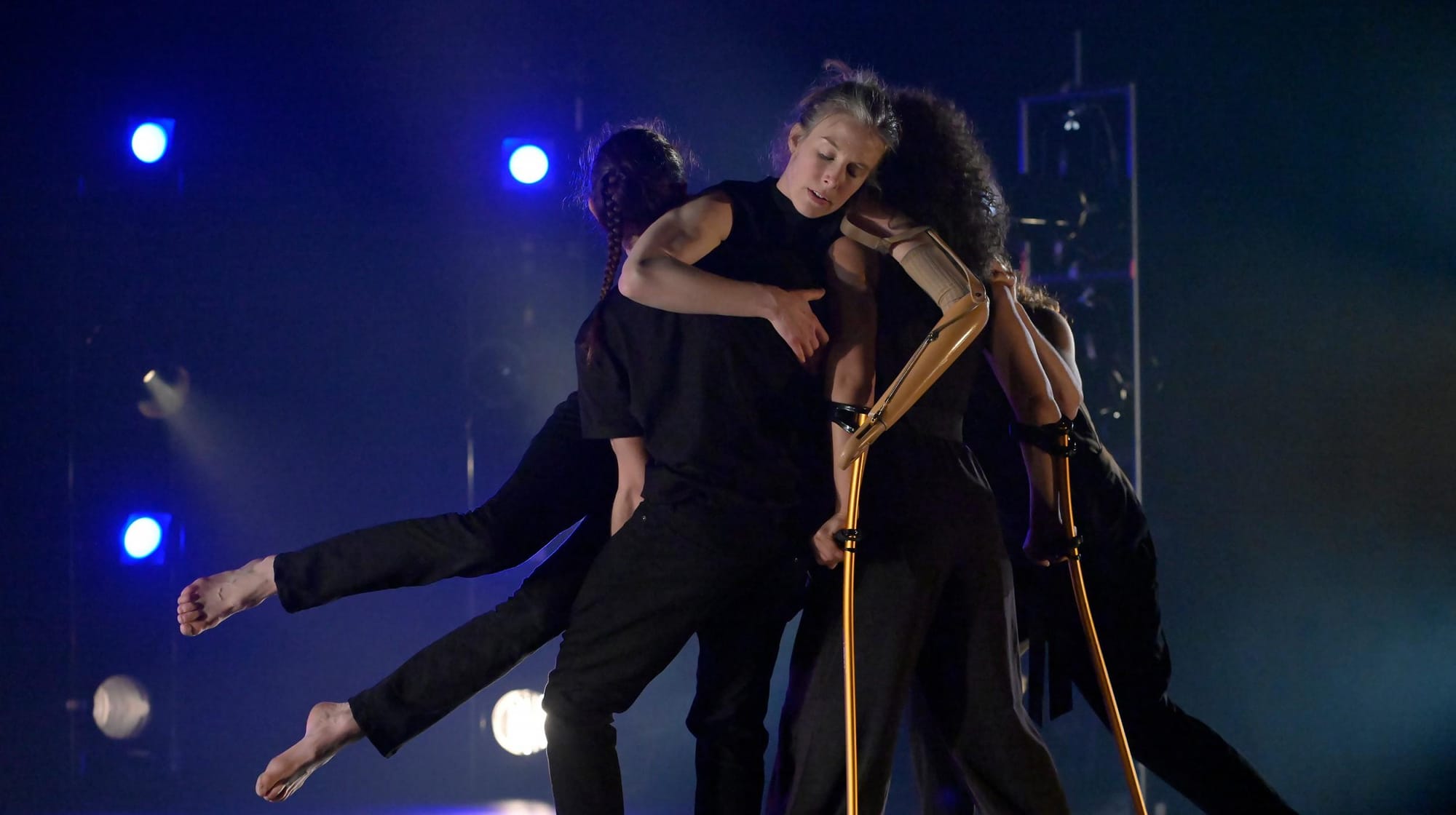
On the 27th of March, Lancaster Arts welcomed performers Annie Hanauer, Laila White, Giuseppe Comuniello, and Deborah Lennie for the first time to present A space for all our tomorrows at their Nuffield Theatre.
Annie Hanauer is an internationally recognised dance artist who began her practice over two decades ago, over which she has worked and collaborated with many other disabled artists. She is “interested in how bodies in motion can joyfully disrupt ideas of normativity,” and how dance as a medium of expression can become a space to challenge those normative ideas.
A space for all our tomorrows did exactly this.
With inclusivity at its centre, the relaxed performance allowed the audience to leave and enter the theatre space at their own comfort, provided captions in English and other languages, along with headsets available with audio description. Hanauer makes a point of addressing and emphasising accessibility not only through the themes of the piece but also its presentation.
The piece began with Deborah Lennie singing on stage, a beautiful voice that immediately entranced you. Live music in conjunction with the hypnotic movements of the dancers added another physical dimension to the production, engaging the eyes, ears and body entirely.
The slow meditative performances delivered by Annie Hanauer, Laila White and Giuseppe Comuniello marked the tone of the show, allowing for a reflective setting for the audience to be absorbed and fully immersed in “a perfect world” of our own imaginations.
Highly interpretive, in a freeform, ecstatic style, the dance itself was a tangible declaration of disabled lives and their resilience and creative prowess. The physical forms of the dancers flowed into one another, speaking to the oneness of their utopia, their many forms merging together in unison. They performed in duets and in groups, embracing each other with care and love to digital sounds of birds. Laila White’s use of her crutches produced stunning choreography, both visually and emotionally striking. The movement and shapes she created with her whole body were extraordinary, extending her crutches up towards the sky or balancing them against her fellow dancers.
I particularly enjoyed the varied use of sound, where I would often be swept by the atmospheric audio. Using techniques like bilateral clicking sounds, alternating from left to right, activating the subconscious brain, lulling and soothing the audience. At other points having a sonorous drum beating like a heart, or technological glitching. Even during durations of silence, our collective attention was brought back to the body as we heard the sound of the dancers’ limbs moving across the floor.
Another remarkable aspect was the overlapping voices and languages. Hanauer collated interviews and conversation from people all over the world about how they view their own utopias. There was diegetic sound alongside these voiceovers, as though the audience itself was in conversation with the voices. The inclusion of multiple languages created a universality to Hanauer’s message, encouraging people to feel part of something unimaginably vast–truly a space for all our tomorrows.
The performance gave a contemplative view of the future, wondering “what it could be like”. The phrase was a powerful one, the repetition of which created a reverberating presence, marking a sentiment of uncertainty but also hope that lingered even when the show ended. A beautiful production with a message it executes with utmost skill and grace.
A space for all our tomorrows was featured alongside Tony Heaton’s exhibition Serial Dissenter in the Peter Scott Gallery, who is also a disabled artist, and I could not help but see the two in context of each other. I believed their artistic voices to complement one another, as though Heaton’s words echoed through the speakers, and Hanauer’s movements were contemporaries to his sculptures.