The 'Barbaric Yawp' of English in Education
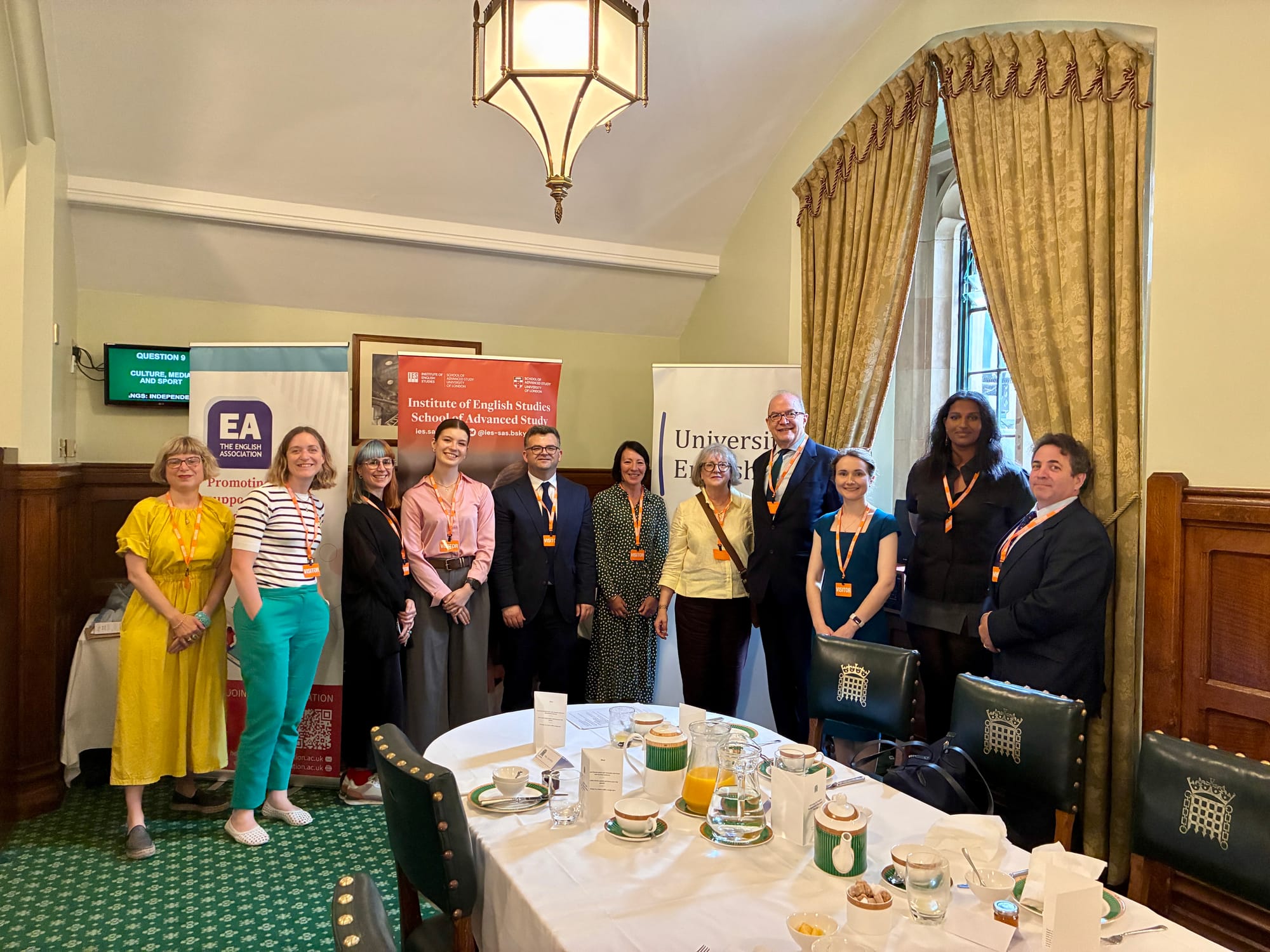
On June 18th, discussions regarding the national importance of English echoed in London's Houses of Parliament by The English Association. The debate leaves us with the question of what it means to be human, and what seat English takes in our classrooms.

In his First Edition of ‘Leaves of Grass,’ self-published in the summer of 1855, Walt Whitman stated the answer to the insatiable question of ‘the self:’
What good amid these, O me, O life?
Answer.
That you are here—that life exists and identity,
That the powerful play goes on, and you may contribute a verse.
This summer, on June 18th, the truth of these words formed verses that were echoed in London’s Houses of Parliament by The English Association, joined by Bloomsbury Press, the Institute for English Studies, and University English at their Parliamentary Breakfast. The organisations promote and celebrate English Studies while working alongside schools and networks. Hosted by the Rt. Hon. the Lord Baker of Dorking CH PC, it was a morning of advocating for English within our schools and society by guests from business, media and Higher Education.
Discussions took place regarding the national importance of English language, literature, and creative writing. As outlined in their Charter, despite producing world-leading research and underpinning to a wide range of sectors, from law and finance to healthcare and public service, English is routinely sidelined in today’s climate. Nigel Newton, founder and CEO of Bloomsbury Press and leading advocate for English Studies, declared the event a huge success, stressing the potential for change harnessed at the Breakfast.
The Parliamentary Breakfast discussed statistics from the National Literacy Trust, including those of 1 in 3 (36.1%) children and young people who said they enjoyed reading in their free time (up from 32.7% in 2025). I look to Maria Montessori, a physician and educator, who reflected on her teaching methods in ‘Education for a New World,’ published in 1946. Specifically, letters. She stated that ‘just presenting single letters in contrast, day after day, made no impression’ on teaching the young children. Meanwhile, after she ‘had let them pass their fingers round the grooves, the children recognised the letters immediately.’ There is a deeper metaphor here than the surfaces of wooden letter blocks.
Perhaps, we can apply Montessori’s experience in teaching to today’s classrooms (where literary information is memorised and regurgitated with no passion, interest or real-world application due to curriculum restrictions). The reports on English studies feel like yawping into a void: the falling coins and banknotes are evidently heavier than letters. Modern educators and educational bodies should be encouraging students to run their own fingers over literary pursuits. It is through English that our students will learn to think critically and question what they read and/or hear, to argue their opinion constructively and sensibly, to uphold opinions based on facts and research.
With the introduction of a national curriculum in 1988, modern standardised examinations and headteacher allocated budgets, learning became memorisation not for self-development and a thirst for knowledge but for performance. However, we see practice and repetition is deemed effective for our biologically secondary knowledge (skills that are cultural and taught, not innate and automatically acquired) by former Schools Minister Nick Gibb and Headteacher Robert Peal in their book ‘Reforming Lessons,’ following the 2010s educational reforms.
This debate, I’d argue, leaves us with the question of ontology and what it means to be human. Is English in its literature, language and creativity internal and vital to our existence, like a blood transfusion? Are the poets, writers and theorists we study on our syllabus simply parts to be constructed into ‘comfortable’ political theory? Does English act as a lens through which we interpret our world, or should we leave vision to optometrists?
Following his attendance at the Parliamentary Breakfast, Lord Chris Smith, Chancellor of the University of Cambridge, reflected on his experience studying literature in his column in The Telegraph. During his interview for a Kennedy Scholarship at Harvard, he was asked how literature could possibly relate to his career plan of politics and public life. He noted his response:
‘The study of English Literature…tells you more about character, relationships, society, joy, sorrow, emotion and intelligence than anything else could.’
With present commentary in the news relying on sensationalism rather than solutions, it’s worth considering the relationship between science and English as a partnership instead of rivalry. This train powered by STEM publicity, carrying haste for job security and career development for young people will soon be teetering and overheating on the tracks. It will reach its assumed destination and run out of steam after realising there are no human passengers left on board. The development of AI, technology, and science will reach a station that cannot go on without the creativity, ethics, and morals of human input. Even though it took engineers and science to construct the train, what is its use if we lack humane incentive? Lord Chris Smith stated:
‘The wit and the intelligence and the understanding of the human condition [is] needed to steer and shape the use of AI…we, of course, need brilliant scientists and engineers in our best universities, but alongside them we will also need the wisdom that comes from an understanding of literature, of philosophy, of history, of economics, of creativity and of social science.’
On the same day as London’s Houses of Parliament heard discussions about English and culture through the Parliamentary Breakfast, The Joint Declaration ‘Europe for Culture - Culture for Europe’ was signed by the European Parliament, the Council of the European Union, and the European Commission. This historic declaration sets out guiding principles for cultural policies in Europe, including a Youth Cultural Ambassadors Network, feedback on AI strategy, an EU Artists Charter and a State of Culture Report. It is the first shared political commitment to culture. Glenn Micallef, the EU Commissioner for Intergenerational Fairness, Youth, Culture and Sport stated:
“This political commitment must now lead to practical progress: fairer conditions for artists and cultural professionals, wider access to culture and stronger cultural communities across Europe.”
Representation of English as a discipline and job sector within culture is crucial in developing solutions for the survival of the area. To put it into perspective, in 2024, 7.9 million workers made up the culture sector in the EU. That is 3.8% of total EU employment. The EU also exported €31.5 billion in cultural goods that same year. Meanwhile, ICT reached 5% in 2024 and agriculture formed 3.9% of the employment in the previous year. While in the United Kingdom, total direct government funding for teaching has fallen by more than 60% since 2010/11. It is no wonder, then, that UK jobs and university courses are uncertain. What is being cut, like a cadaver on an operating table, is opportunity to experience life as more than organs for harvest. Our future doctors, scientists and engineers may prolong our lives, but they will not be lives worth living. Eventually, our hearts and minds will be dissected and found empty. Professor John Schad reflected on the role of the university at this time:
“For a host of reasons, right across the English-speaking western world, the study of English Literature has been put under extraordinary pressures. However, in the age of artificial intelligence, the practice of gathering around a literary text, like beggars sheltering in a storm, will prove of the most powerful ways in which we might yet learn to become human, and that is the ultimate vocation of any university.”
Guests of the Parliamentary Breakfast reflected on how their English degrees have aided them in their careers in public life, business, and media, becoming the examples and representations that young people and future students are in dire need of:
Laura Saunderson undertook a Bachelors in English and MPhil in Medieval and Renaissance Literature and is now a Managing Director and a senior member of the Board and CEO Advisory Practice at Russell Reynolds Associates.
BBC Journalist, Writer and Broadcaster Samira Ahmed stated that her English Literature and Language degree was fundamental to her journalistic career.
According to HEPI, eight of the ten fastest growing sectors employ more Arts, Humanities and Social Science graduates than STEM graduates due to the desired skill sets. At the moment, studying English Language and Literature appears questionable. I hear, “What do you want to do with that? Teach?” when asked about my future career prospects. I could teach. I could teach empathy, creativity, understanding, debate, passion, love, pathos, communication, determination, ambition.
Young people are not made aware of their options. English has become shy, as if we are all insecure poets portrayed as hermits in our houses built of books (not that that’s a bad way to live, I’m also running out of space on my shelves). Science may have built loudspeakers, but it is words that construct meaning. Considering recent events, I ran my own small-scale investigation into Humanities career awareness in GCSE students by returning to my secondary school with a short questionnaire. When the students were asked what they liked about their English lessons, it was their teacher specifically that was a highlight alongside the excitement of getting stuck into a text. They expressed a desire for more active opportunities, creative writing, acting, group interaction, and personal influence in what they learn. The students expressed the content was repetitive and focused only on exam technique.
Instead of allowing our classrooms to be as colourful as our young people’s imagination, the system is attempting to build a robotic routine that thrives efficiently in STEM fields but fails in dynamic, creative subjects such as English language or literature. Following a question about career availability, science careers formed lists of valid and valuable professions, while the Humanities/English list was mostly as blank as a new notebook. Science pursuits are vital for our technological development, but are we teaching our students to become the machines rather than the brains?
The English Association is actively influencing the conversation surrounding English, speaking aloud as if at a poetry reading, through initiatives such as the #EnglishCreates: Futures Online Synopsium that took place on 2nd July with over a hundred sign-ups. This day of panels and discussion explored what futures are possible for English studies in universities, schools, public culture, industry, and beyond. Through projects like ‘Skills for the Future of English,’ and ‘English Opens Doors,’ the organisation provides practical, research-informed materials that highlight the future-facing, real-world skills developed through English study - perfect for curriculum planning, advocacy and student engagement.
Professor Steve Decent, Vice-Chancellor of Lancaster University (as a mathematician!) supported the cause:
“With the developments of medicine and science, humans are living longer and healthier lives, and the humanities and our cultural disciplines contribute to making those longer lives worth living.”
Verses should not be written solely under timed conditions in a cold hall, and plays should not be hidden behind curtains. They cannot be written only in blood with a scalpel, typed in code, or generated by an unfeeling machine.
What verse are you contributing?
Sources:
https://www.telegraph.co.uk/news/2026/06/23/andy-burnham-about-to-prove-true-worth-cambridge-english/?msockid=2b02b4542b8e609d1d4fa2a02a3861ad
Walt Whitman, Leaves of Grass: The First (1855) Edition
https://englishassociation.ac.uk/charter-for-change-launched-at-westminster/
Maria Montessori, quote from Education for A New World (1946)
https://eur-lex.europa.eu/eli/C/2026/3440/oj/eng
Higher education finances and funding in England - House of Commons Library