The War of the Worlds - Interview with Andrew Quick
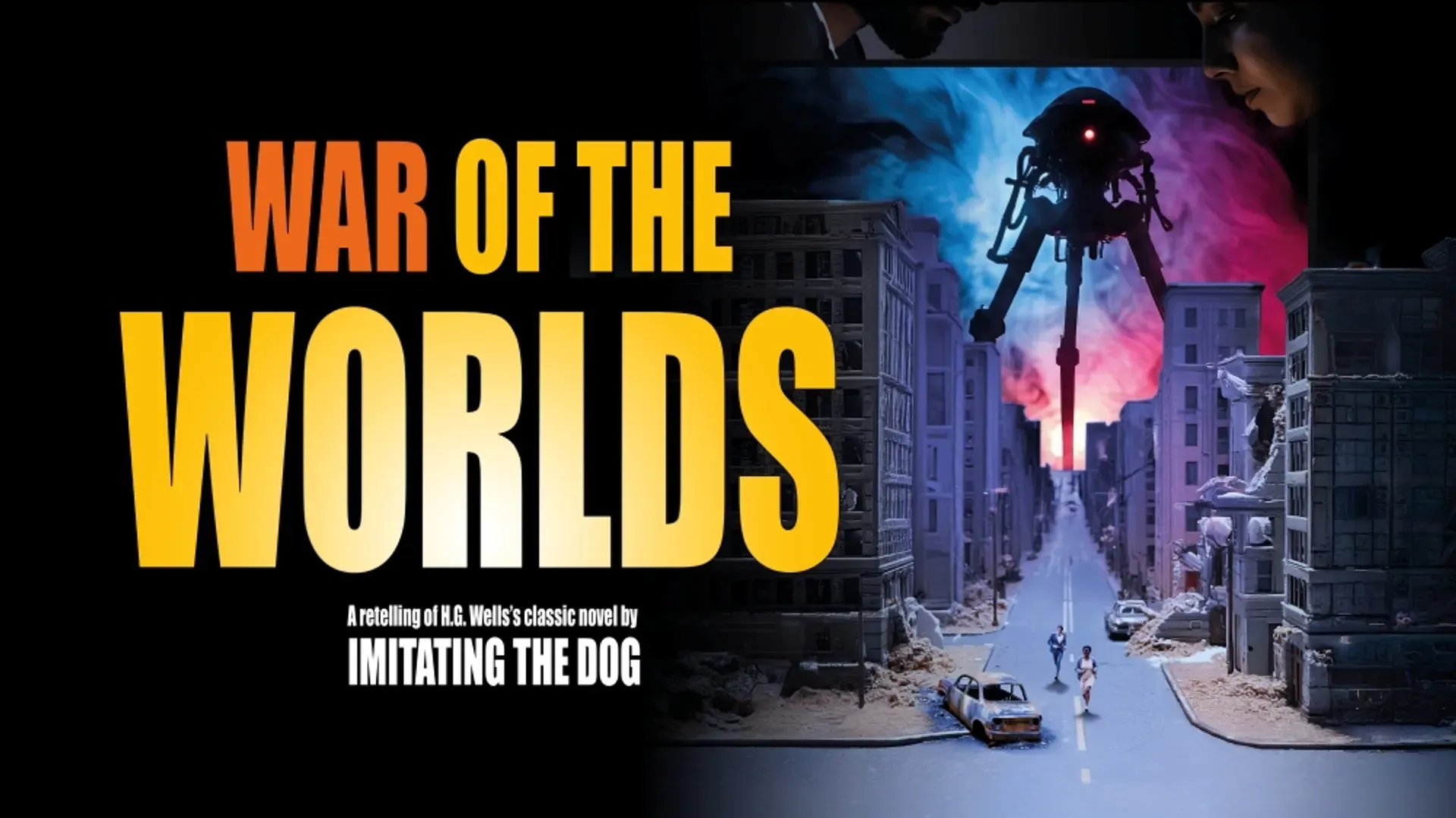
SCAN writer Grace Crossley had the opportunity to sit down with Andrew Quick from theatre company imitating the dog to discuss their upcoming adaptation of The War of the Worlds, showing at The Dukes in February. Here’s what Andrew had to say about technology in theatre, adapting literary classics, and how storytelling can reflect the world around us.
Andrew Quick is co-director, co-writer, and Artistic Director for imitating the dog’s 2026 production of The War of the Worlds, an adaptation of the sci-fi novel written by H.G. Wells in 1898.
imitating the dog has been incorporating modern technology, cameras, and projections to provide unique retelling of well-known literary classics for the past decade, alongside installations and other projects since the company was founded in 1998.
imitating the dog has adapted many different literary classics in the past, what drew you to adapting War of the Worlds in particular?
“It’s a really interesting novel. Its ideas around fear of invasion are fascinating and when HG Wells wrote it, there was a parody, or a kind of pastiche, of invasion literature which was happening in the 19th century. We started to think about how there's a lot of fear at the moment about migration and a lot of the kind of language around it is often about invasion, aliens, outsiders, and we started to get interested in that rhetoric and how we might relate that language to Orson Welles' original radio play.
When we started to think about that, we got very excited about doing the adaptation and we started to think, what better time than now with the kind of Trump worldview to do something that relates war, catastrophe, migration, fear of invasion than the times we're living in now. All those things sort of came together and we got very excited about a project that we'd always been interested in but pushed away when we actually came down to it.”
When adapting literary classics, how do you choose which parts of the novel to adapt and which to remain the same?
“When we did Frankenstein, I did do quite a lot of the original novel, but I juxtaposed it with a story, a modern story of a couple trying to have a child or living with the fact that one of them was in pregnancy in a very sort of in a world on the edge of catastrophe. I took the spirit of the novel and had a parallel text. I had the original going on one way, then I had this parallel, and there was a point where the two merged, and that's the kind of classic sort of entwined storytelling.
With War of the Worlds, there's certain characters from the original in our adaptation, but it's not set in 1895 in Dorking and Woking in the South. It's set in 1968 around London, but very similar things happen in the novel. It's the spirit of the novel and the kind of, not just the spirit of the novel, but all the other literature and influences that novel has made, cinema, television, that kind of feeds into our adaptation.”
Was there any particular reason you chose London in 1968?
“1968 was when Enoch Powell made a very famous speech called the ‘Rivers of Blood’ speech, which was an articulation of, I suppose, white British fear of migration into this country. That speech is the kind of frame that frames our story.
The main character, Will Travers, is attending a rally just after that. He's kind of a racist or a someone who believes in that kind of ideology, and he creates in this moment of paranoia and violence this world it falls into. I think what we're trying to do in a way is equate the Martians and the devastation they cause with fascism. In the piece it's not an absolute analogy but it's definitely hinted at.
The other answer to that question is a lot of our shows we create a kind of stylistic difference. 1968 is a really great period because it's a time of great social change. You know, you've got the late 60s, you've got the civil rights movement happening in America, the assassinations of Martin Luther King, Robert Kennedy, all in the same year. The problem with doing it now is it's difficult to be contemporary stylistically, whereas the 60s, which I was eight in 1968, so I have a bit of a memory about it, but when you're in the 70s, you can sort of hop back to the 60s. It just feels like a really good style.”
What’s been the most difficult part about adapting The War of the Worlds?
“Making theatre is very expensive. And even though we’re playing in theatres that have maybe 600 people in, you can't afford too many actors. When we did Macbeth, we had five actors. We had two actors, one playing Lady Macbeth, one playing Macbeth, and we had the three witches. And what we liked about that was the three witches created the world, they were the filmmakers as well, created the world in which the Macbeths fell into, a bit like they do on stage, so that's what we've done in War of the Worlds.
At the beginning is this man has been in a sort of very bad accident at a political rally, where he's been injured by a police horse, and he goes into hospital. And then he constructs the world of War of the Worlds out of the last image he sees in his consciousness, the nurses, the doctor, his wife. Then he falls into this really surreal, terrible world of Martian invasion. So that's the conceit. So the nurses and the doctors play all the other characters and they are the film, they're filming as well. And you could see it like while they're operating on him whilst he's they're trying to save him, he's looking up at these sort of strange people and he's constructing this another reality that is sort of keeping him alive. Does that make sense?”
Moving on to imitating the dog as a company, what draws you to using technology in your shows and installations?
“I think the easy answer to that is that we use technology in theatre because people are using technology in their lives. It's part of a new reality of human experience, so one of the things that we're trying to do is understand the experience is already, to a certain extent, affected by technology. The technology doesn't just frame the work., it’s embedded in the work. The actors have to deal with what I would call a sort of technological architectural space, and they have to negotiate it.
If you come and see the show, you'll see that they have to hold a camera. They might hold a prop, they have to move over there, then come back into character. It's very sort of Brechtian in that style, where they're real for a minute and then technical in another minute. And that, for me, is really interesting.”
Finally, what can the audience expect when they see your production of The War of the Worlds in February?
“I think they can be really excited by how we stage it, with the visual tricks that we play. If they leave going ‘oh my god, that was an extraordinary experience’, that would be great. Another thing they can expect is a tight story told but it has these other layers of meaning and I really hope they get that and have fun with that as well.
It’s a very fast story, being made right in front of you, shot by shot. It’s 1,200 shots, live, making a movie in an hour and a half in front of an audience and it’s pretty seamless up in front of them.
It’s got the Martians, tripods, everything you can expect from the original, but told in a very dynamic different way and I think audiences will enjoy it.
imitating the dog’s production of The War of the Worlds will be performed at The Dukes in Lancaster on 18th-21st February. Tickets are available on The Dukes’ website.